

Connected classroom in a partner ministry
NDX Education logo
Republic of Ghana Ministry of Education crest

NDX Nexus Dynamics - Digital transformation for K-12 educationNDX

Ghana Intelligent Classrooms Initiative

Better classrooms. Stronger learning. A national demonstration programme for sovereign, curriculum-aware educational intelligence.

NDX Education proposes 1,000 solar-powered, offline-first intelligent classrooms across selected Basic and Junior High Schools, creating evidence for national scale-up from January 2027.Proposal

Intelligent classrooms
1,000

Basic and Junior High Schools across Ghana

National coverage
16

Regions included in the demonstration design

Teacher capability
10,000+

Educators trained, mentored, and supported

Scale-up pathway
Jan 2027

Evidence-led national expansion planning

Prepared for

Ministry of Education and CENDLOS

Submitted by

NDX Education

Delivery partner

Data Systems Ltd

Programme path

2026 demonstration to 2027 rollout

Proposal intelligence tabs

The rationale, policy fit, and NDX value in one place.

These tabs give Ghana decision-makers the why behind the proposal: why Basic and Junior High Schools, why now, how the programme aligns to public policy, and how NDX creates a credible route from ministerial vision to classroom impact.

Why this proposal now

A practical response to Ghana's classroom, curriculum, and AI moment.

The proposal is not a device rollout. It is a national demonstration of how Ghana can move from digital education ambition to daily classroom use across Basic and Junior High Schools.Proposal

Value proposition

  • - 1,000 classrooms create a meaningful national evidence base without committing the whole system at once.Proposal
  • - Offline-first and solar-backed design makes the model relevant beyond urban connected schools.Proposal
  • - The demonstration creates hard evidence for learning impact, teacher adoption, infrastructure resilience, and value for money.Proposal

Basic education is the foundation layer

Primary and Junior High School are where literacy, numeracy, science confidence, digital competence, and learning habits compound. Improving this stage improves later SHS, TVET, STEM, and workforce outcomes.NaCCA
The curriculum needs an operating layer

Ghana's curriculum reform creates clearer competencies and learning expectations. Intelligent classrooms help translate those expectations into lesson planning, assessment, multimedia explanation, teacher support, and evidence.NaCCAProposal

AI must be governed, local, and useful

The proposal gives Ghana a controlled way to test AI in education with teacher-in-the-loop practice, curriculum grounding, local data stewardship, and a national readiness model before wider scale-up.ProposalNDX

Concept deck synthesis

Educational intelligence infrastructure for real Ghanaian conditions.

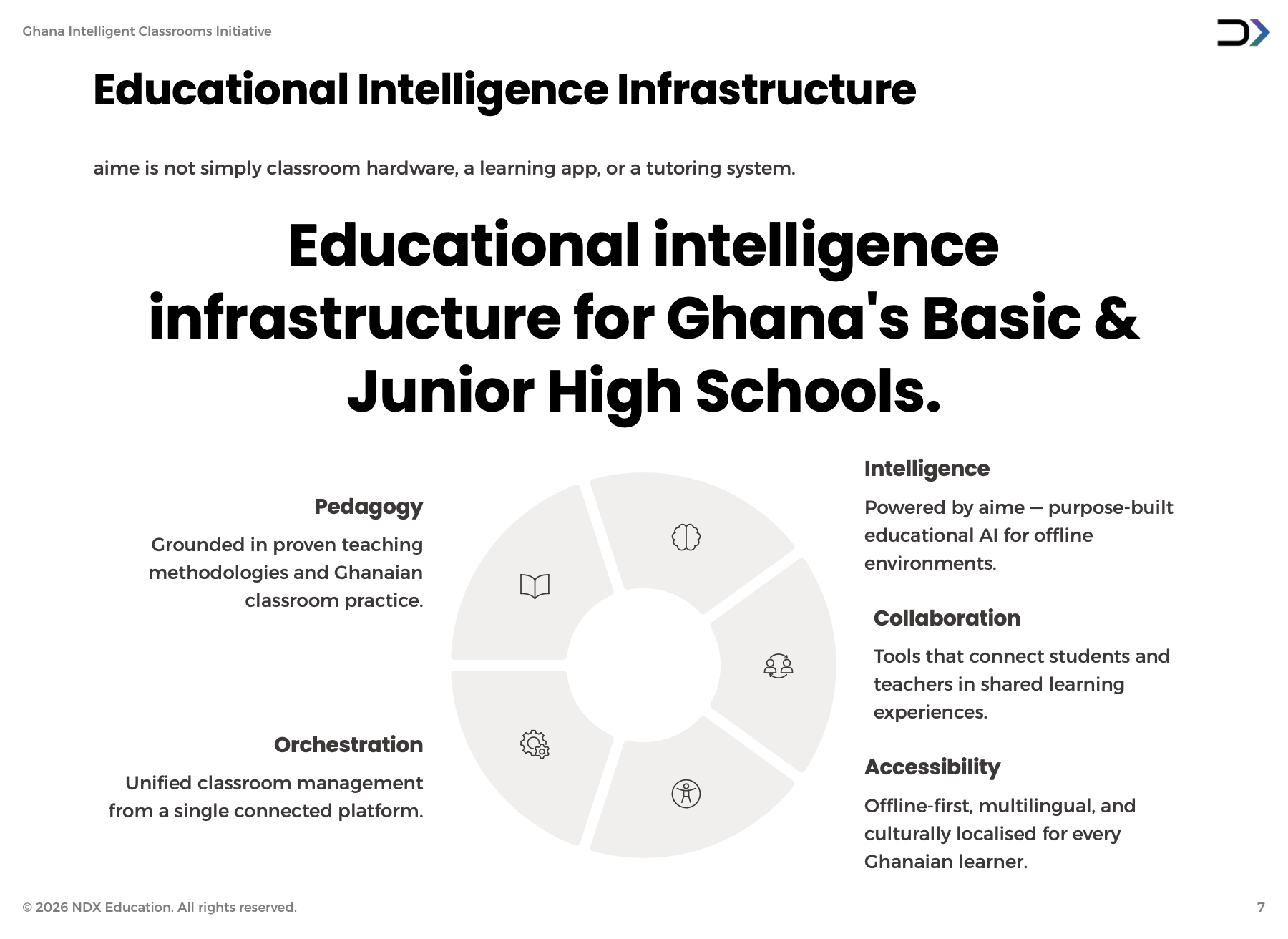
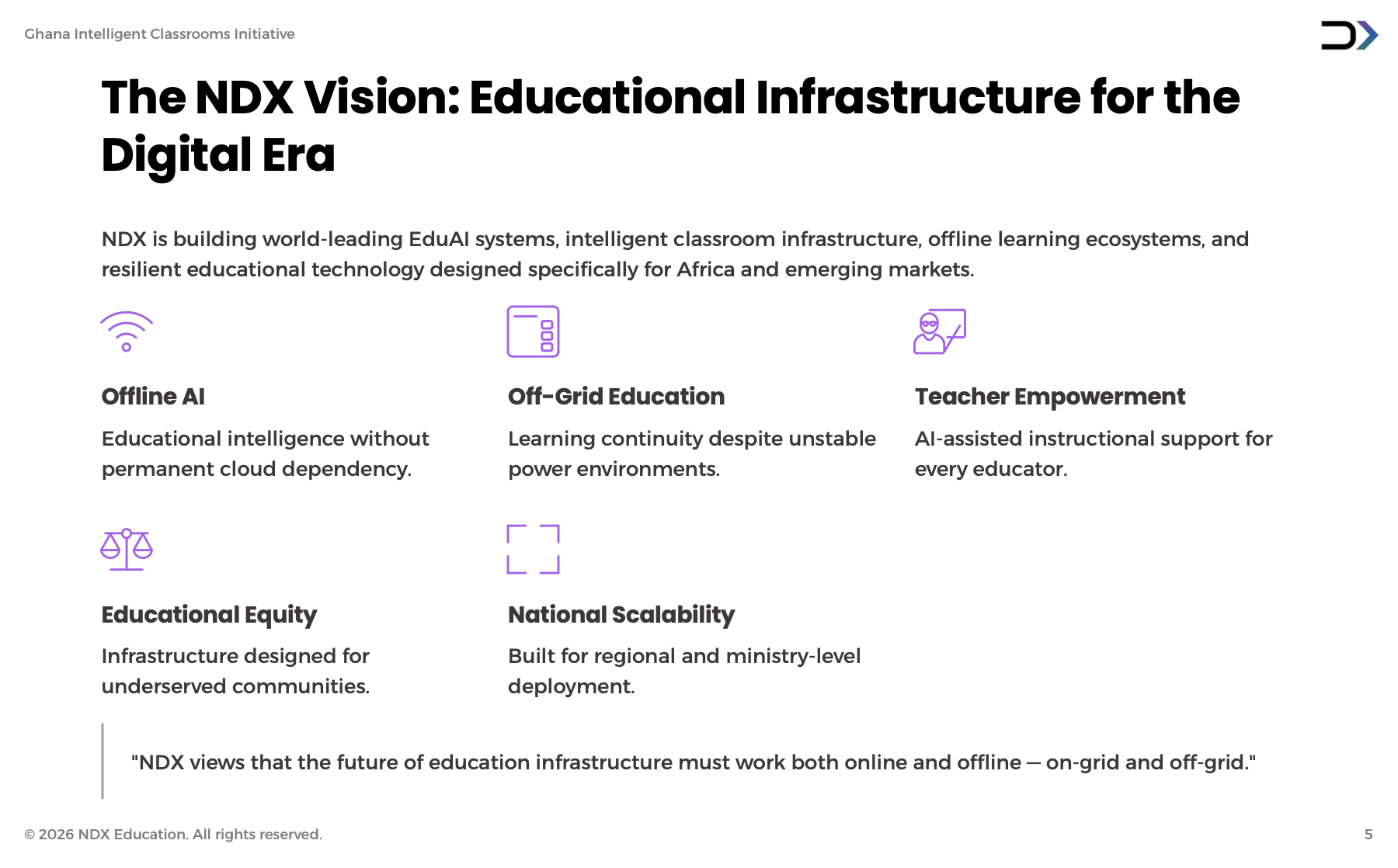
The concept presentation sharpens the value proposition: this is not a hardware deployment, a tutoring app, or classroom digitisation. It is AI-enabled, offline-first educational digital infrastructure built to work online and offline, on-grid and off-grid.Concept

Concept slide showing the NDX vision for educational infrastructure in the digital era
Concept deck: NDX vision for educational infrastructureOpen full image

Not classroom digitisation

The concept deck reframes the initiative as future educational infrastructure for Ghana: intelligent, resilient, locally grounded, and designed for national scale.Concept

Teacher capacity multiplier

aime supports teachers with lesson planning, content generation, instructional sequencing, curriculum alignment, and faster classroom delivery.Concept

Works online and offline

The platform is built for real school conditions: local content hosting, offline orchestration, smart synchronisation, low-bandwidth operation, and solar-backed continuity.Concept

Learning that travels

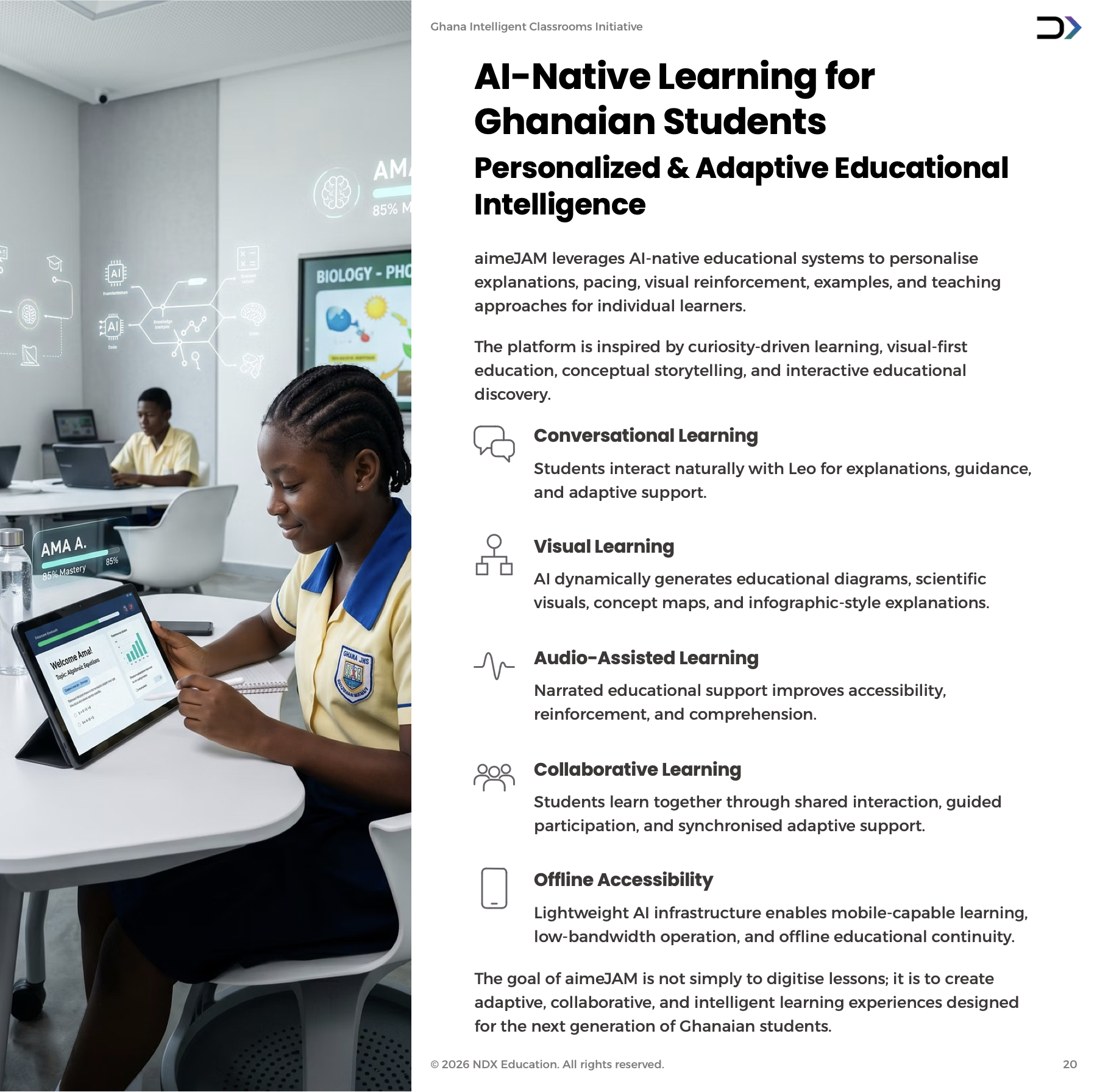
aimeJAM and Leo extend learning through interactive, visual, conversational, collaborative, adaptive, and offline-capable student experiences.Concept

Local language and culture

The Ghana model emphasises curriculum, Ghanaian languages, local examples, regional realities, and culturally relevant learning experiences.Concept

Proof before national scale

The Cameroon pilot outcomes show strong positive signals for educational value, curriculum alignment, teacher time saving, localisation, and offline AI vision.Concept

Executive case

A Ghana-led model for intelligent, resilient classrooms.

The proposal is designed to validate educational outcomes, teacher adoption, infrastructure performance, implementation methodology, and national readiness before broader deployment from January 2027.Proposal

Strengthen teaching and learning

Improve curriculum delivery, lesson preparation, classroom engagement, and measurable learning outcomes.

Empower teachers

Provide practical tools, professional development, and AI-assisted support that strengthens instructional practice.

Expand equitable access

Reach urban, peri-urban, rural, and underserved communities with resilient, offline-first learning environments.

Build future-ready skills

Develop digital literacy, STEM confidence, computational thinking, problem-solving, and AI awareness.

Strengthen resilience

Use solar-powered infrastructure and local content delivery to keep learning available in diverse conditions.

Create a foundation for scale

Generate evidence, certified national capability, and governance models for future national deployment.

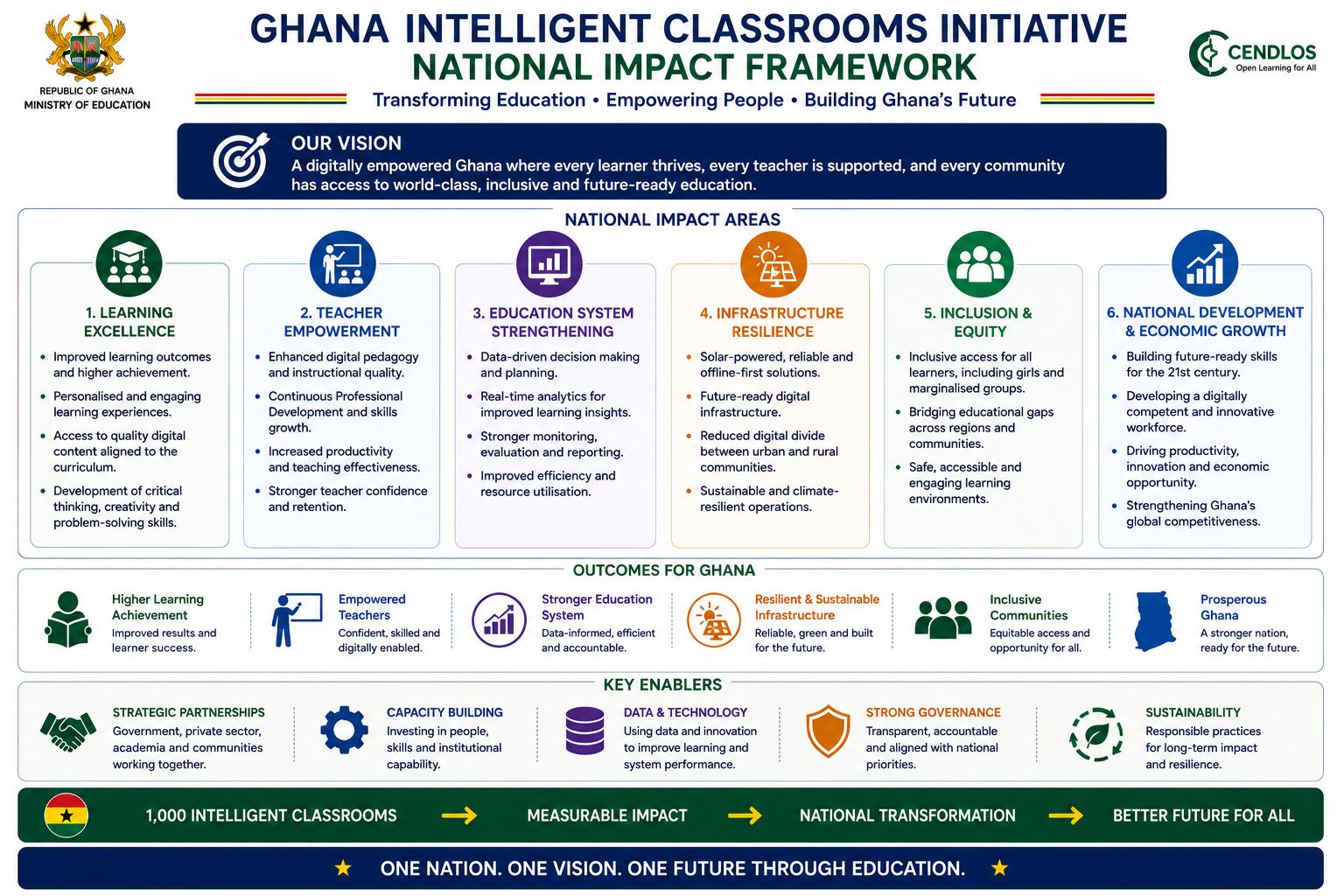
National impact framework

Six national impact areas, one programme architecture.

The initiative connects learning excellence, teacher empowerment, system strengthening, infrastructure resilience, inclusion, and national development into a single outcomes framework.Proposal

Ghana Intelligent Classrooms Initiative national impact framework
Exhibit 1: National impact frameworkOpen full image
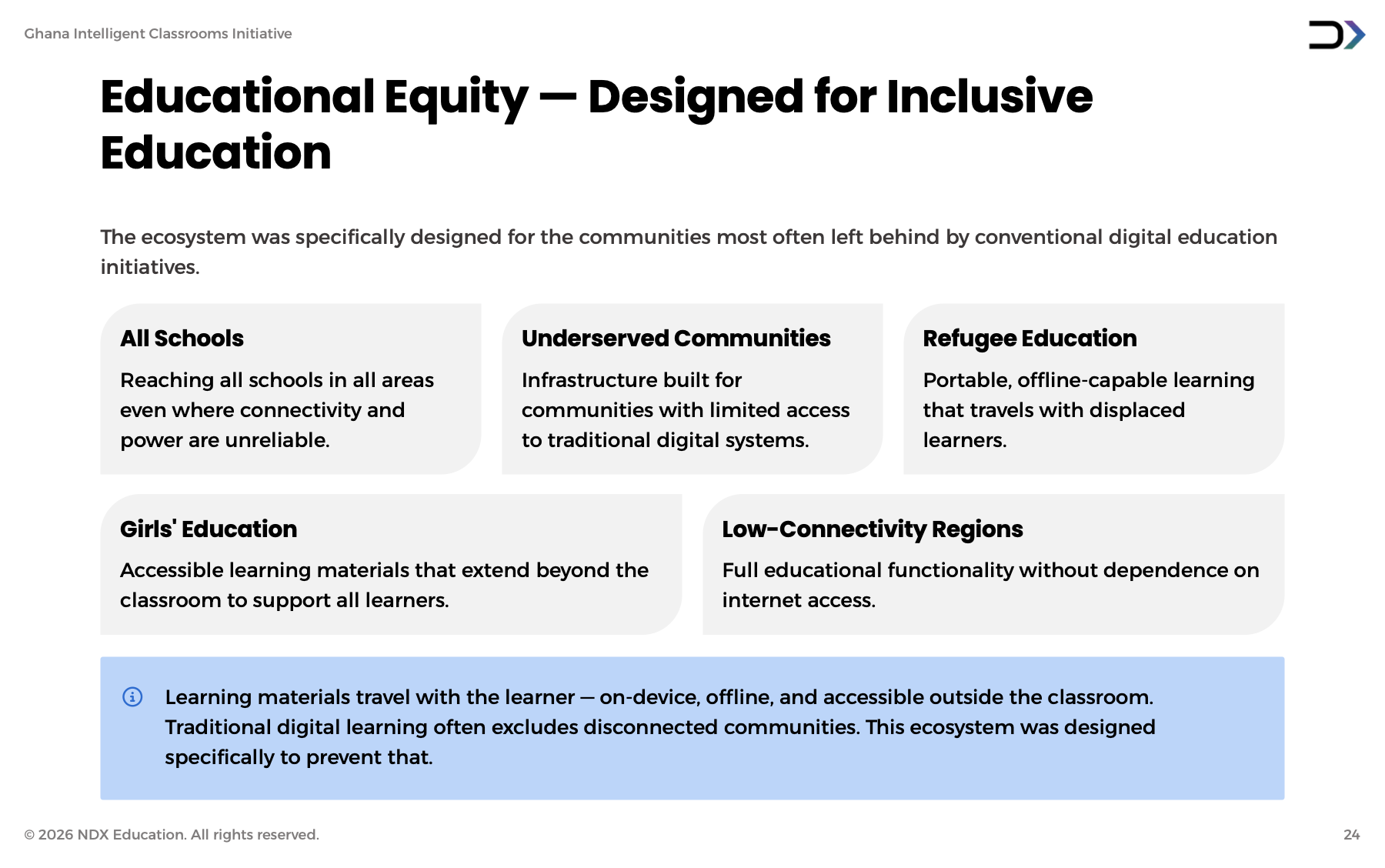
Concept slide showing educational equity designed for inclusive education
Concept deck: Educational equity and inclusive reachOpen full image
NDX classroom transformation concept

NDX proposal lens

Most edtech adds another app to the classroom. NDX modernises the whole classroom.

The Ghana programme is structured around an integrated education intelligence platform: classroom infrastructure, teacher workflows, local content, curriculum alignment, analytics, and national governance working together.ProposalNDX

Sovereign by design

A Ghana-led programme structure with national education authority, curriculum alignment, and controlled scale-up.

Integrated, not fragmented

Hardware, content, AI, classroom workflows, teacher development, and reporting operate as one learning environment.

Intelligent and curriculum-aligned

AIME supports the teacher with local context, curriculum-aware generation, assessment support, and classroom insight.

Resilient and inclusive

Solar power, local services, offline-first content, and national coverage make the model viable across diverse communities.

Platform architecture

Curriculum-aware intelligence, powered locally in the classroom.

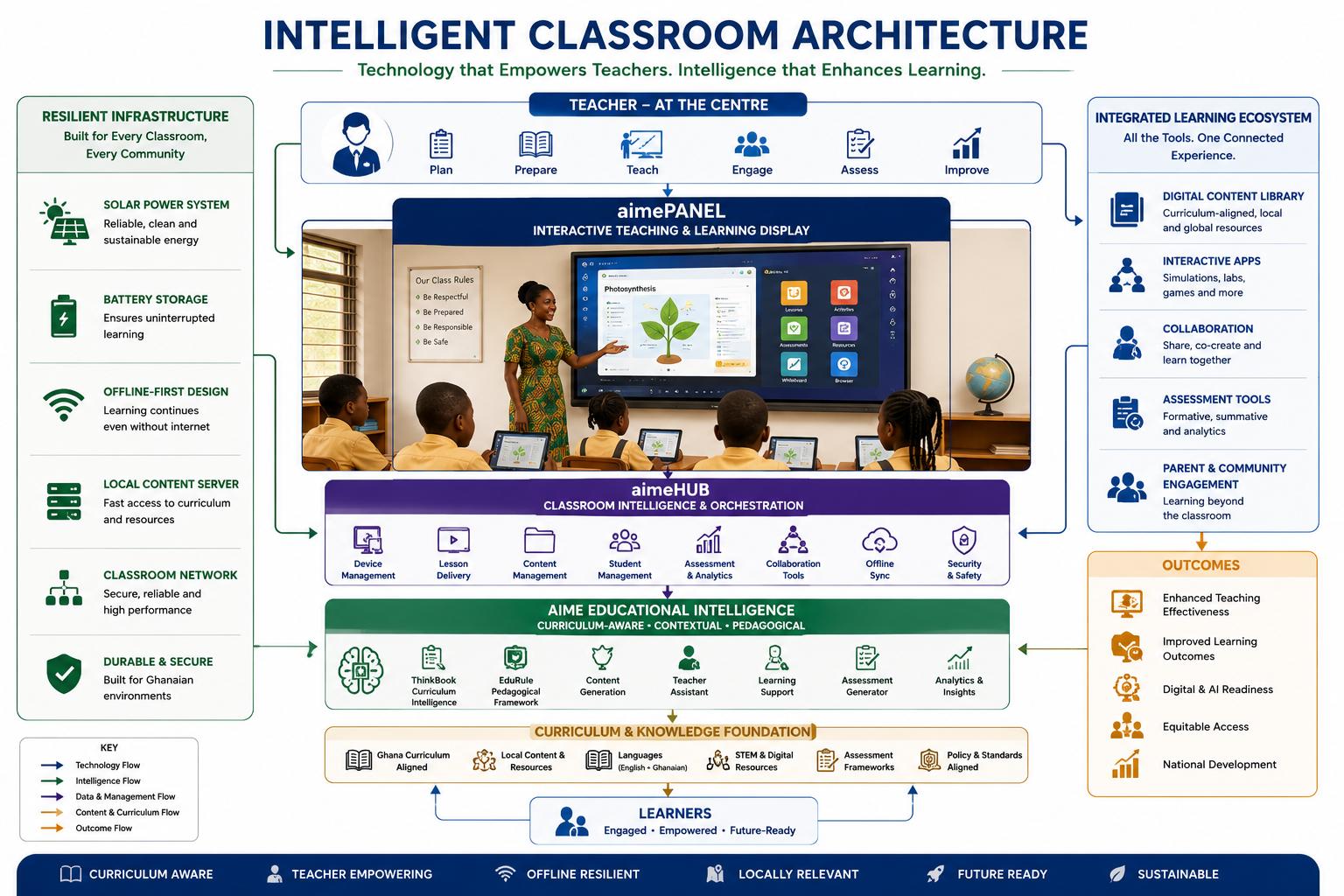
The classroom ecosystem combines the aimePANEL, aimeHUB, AIME educational intelligence, local content delivery, solar power, analytics, and teacher-centred workflows. The design supports teachers rather than replacing them.ProposalNDX

01

aimePANEL

Interactive teaching and learning display for collaboration, presentation, and active classroom participation.

02

aimeHUB

Classroom intelligence and orchestration engine for local resources, device management, and offline continuity.

03

AIME for Education

Curriculum-aware educational intelligence for planning, assessment, content generation, and teacher assistance.

04

Offline-first infrastructure

Local content access and classroom services designed to operate when connectivity is limited or unavailable.

05

Solar-powered resilience

Reliable energy infrastructure for uninterrupted classroom operation across Ghanaian school environments.

06

Analytics and reporting

Evidence for teacher adoption, learner engagement, infrastructure performance, and national readiness.

Intelligent classroom architecture diagram
Exhibit 2: Intelligent classroom architectureOpen full image
Concept slide defining educational intelligence infrastructure for Ghana Basic and Junior High Schools
Concept deck: Educational intelligence infrastructureOpen full image
Concept slide describing AI-native learning for Ghanaian students
Concept deck: AI-native learning for Ghanaian studentsOpen full image

Demonstration programme

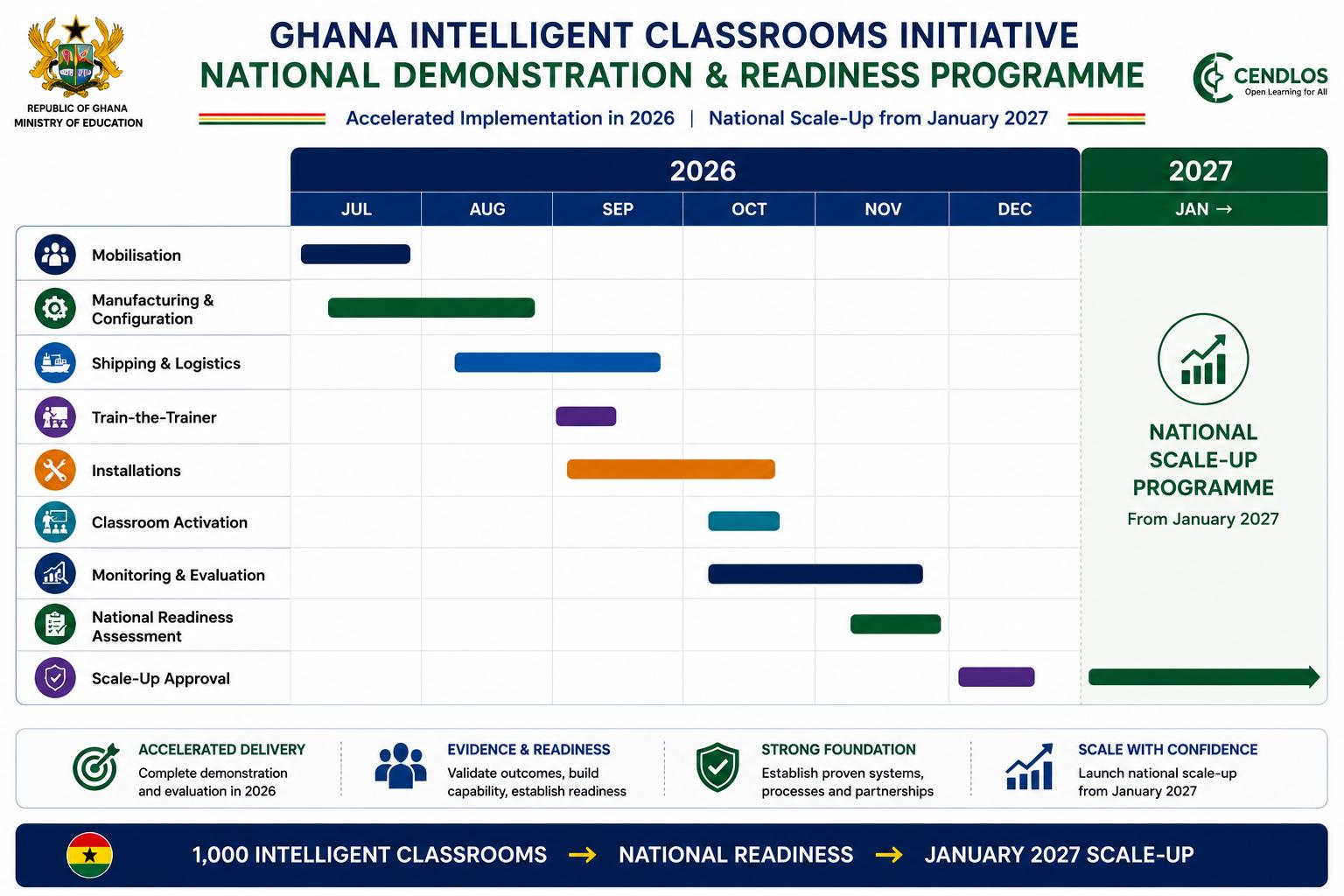
An accelerated 2026 path to national readiness.

Subject to contract execution and mobilisation funding, the implementation roadmap is structured to complete deployment, activation, evaluation, and readiness assessment during 2026.Proposal

30 Jun 2026

Contract signature

Formal approval and mobilisation funding.

Jul 2026

Programme mobilisation

Governance, PMO, stakeholder engagement, school confirmation, and deployment planning.

Jul-Aug 2026

Manufacturing and localisation

aimePANEL, aimeHUB, AIME, curriculum content, languages, and QA readiness.

Aug-Sep 2026

Logistics and capability

Shipping, warehousing, site readiness, and Train-the-Trainer certification.

Sep-Oct 2026

Deployment and commissioning

Installation, solar infrastructure, network configuration, testing, and handover.

Oct-Nov 2026

Activation and evaluation

Live classroom use, CPD delivery, monitoring, evaluation, and readiness evidence.

Dec 2026

National readiness review

Recommendations for future expansion and January 2027 scale-up planning.

National demonstration and readiness programme roadmap
Exhibit 3: Readiness roadmapOpen full image
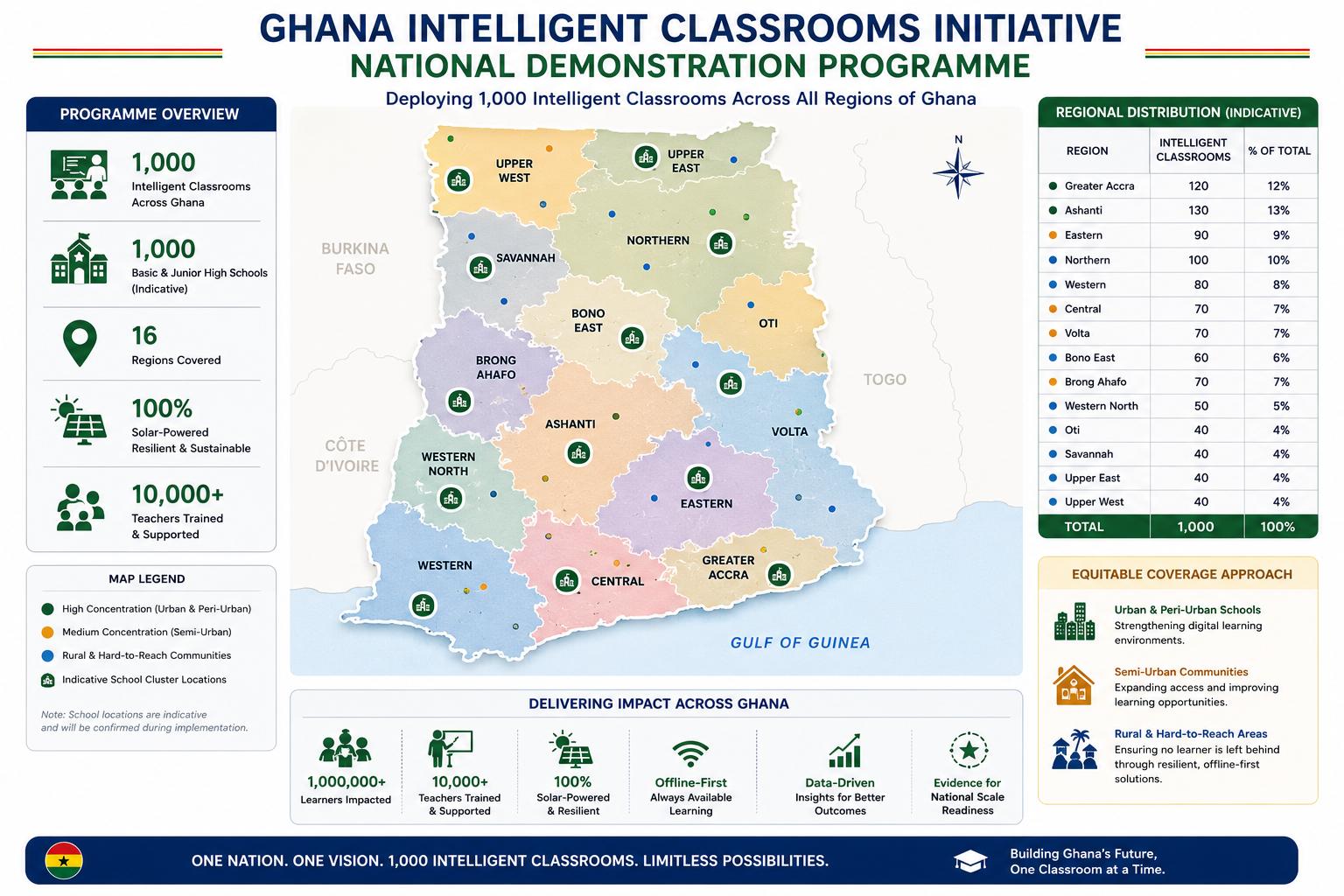
Regional distribution map for the national demonstration programme
Exhibit 4: Regional demonstration mapOpen full image
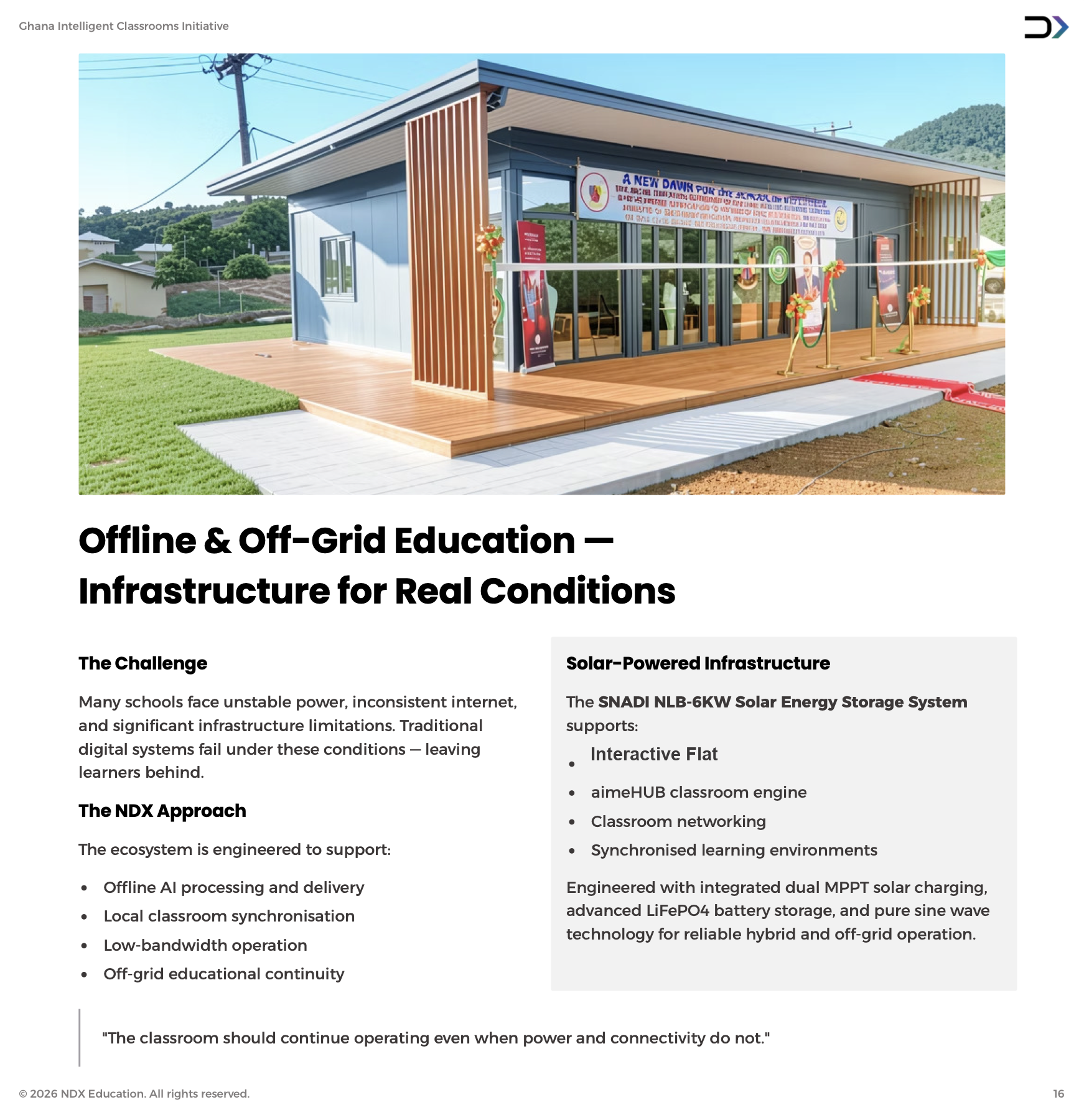
Concept slide showing offline and off-grid education infrastructure for real conditions
Concept deck: Offline and off-grid educationOpen full image
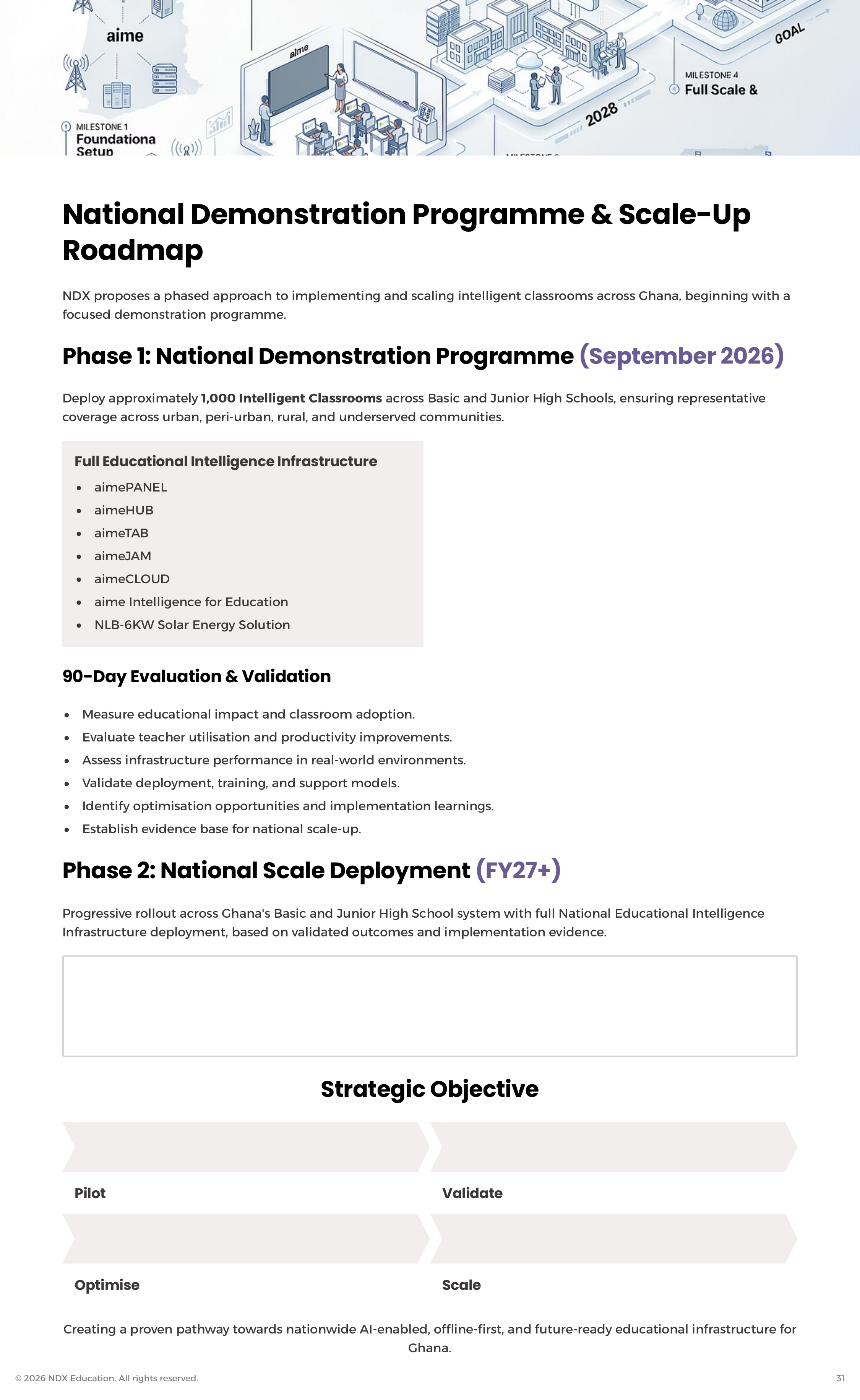
Concept slide showing national demonstration programme and scale-up roadmap
Concept deck: Demonstration and scale-up roadmapOpen full image

Partnership and governance

Clear ownership, single accountability, local capability.

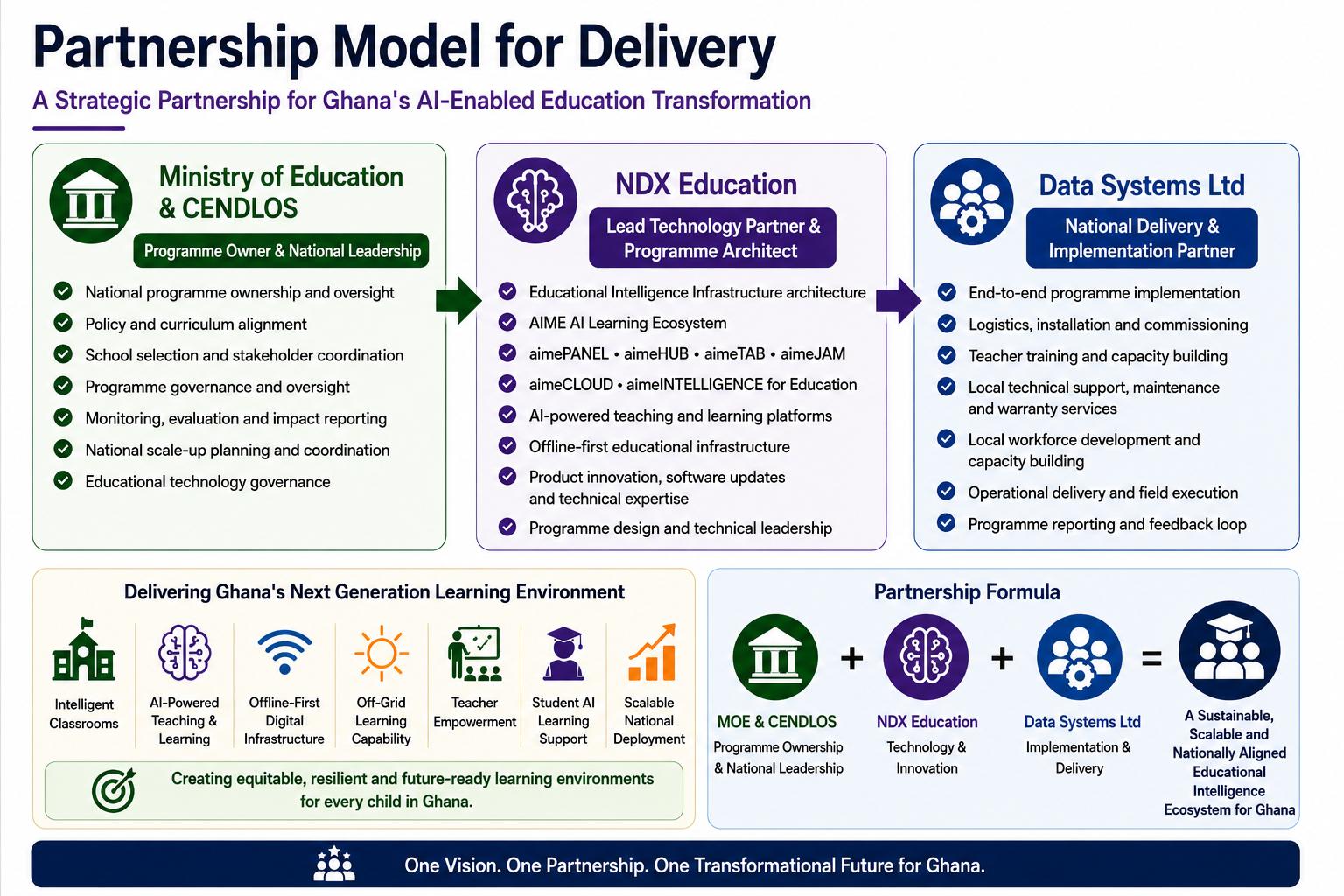
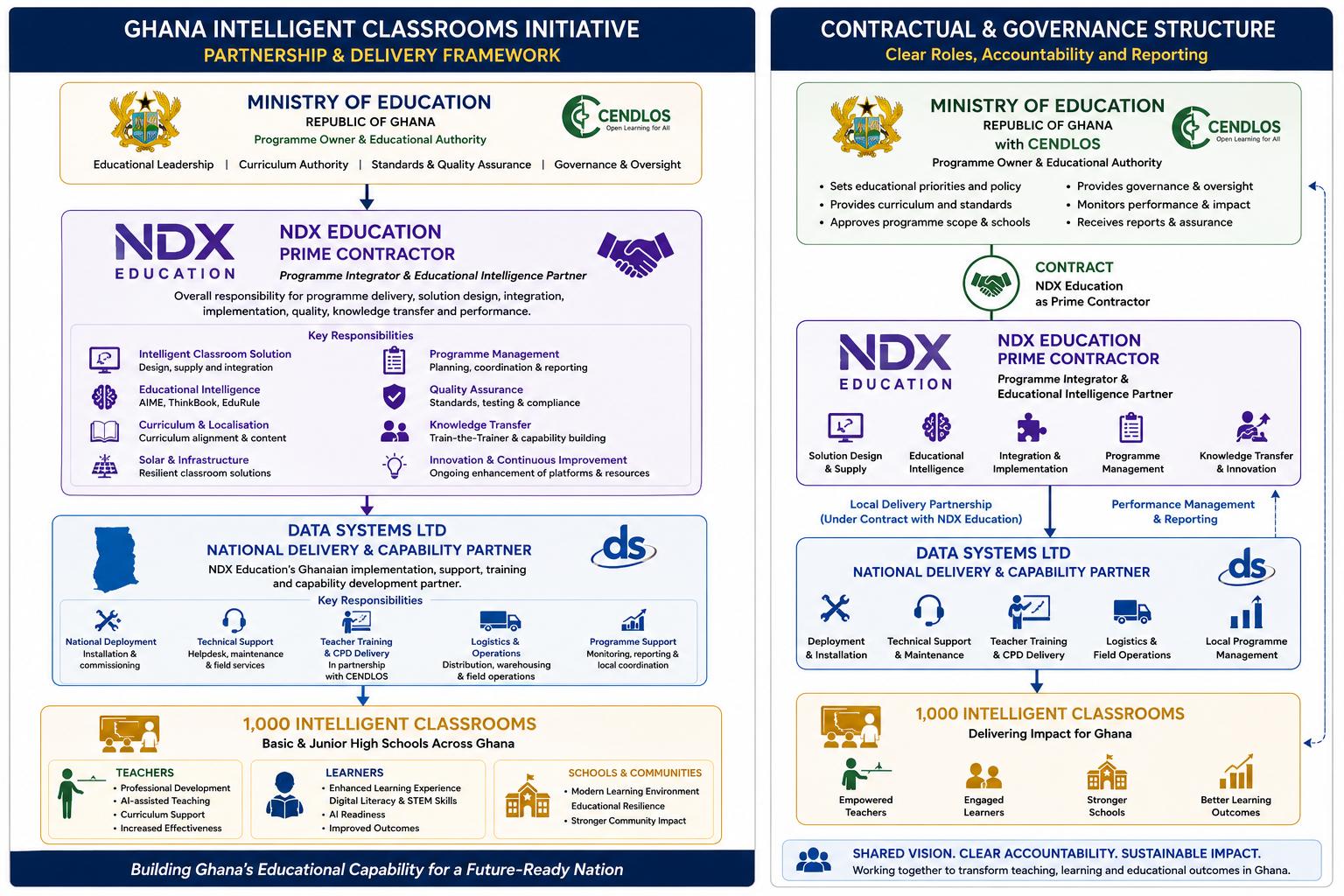
The model combines national educational leadership, NDX Education as prime contractor and programme integrator, and Data Systems Ltd as Ghanaian delivery, training, and support partner.Proposal

01

Ministry of Education and CENDLOS

Programme owner and national education authority

  • - Policy leadership
  • - Curriculum and standards alignment
  • - Governance and oversight
  • - Impact review

02

NDX Education

Prime contractor and educational intelligence partner

  • - Solution design and supply
  • - AIME ecosystem
  • - Programme management
  • - Knowledge transfer

03

Data Systems Ltd

National delivery and capability partner

  • - Deployment and installation
  • - Technical support
  • - Teacher training
  • - Local operations
Partnership model for delivery
Exhibit 5: Partnership modelOpen full image
Contractual and governance structure
Exhibit 6: Contractual and governance structureOpen full image

Capability transfer

Building Ghanaian capacity for sustainable impact.

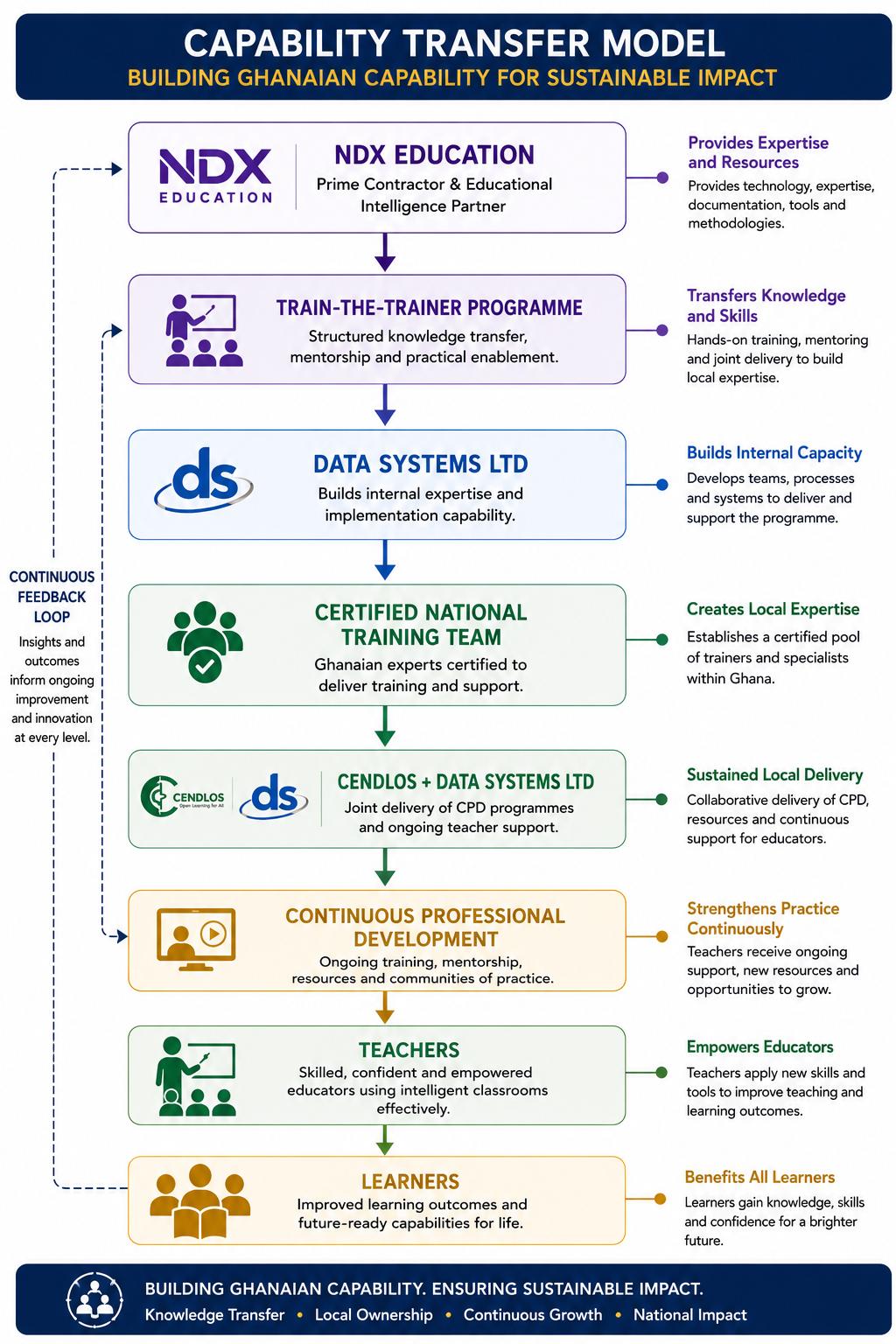
Knowledge transfer is embedded from the outset: NDX provides expertise and resources, Data Systems builds national delivery capability, CENDLOS supports CPD, and teachers gain confidence through continuous professional development.Proposal

Higher learner achievement through more engaging, curriculum-aligned instruction.

Empowered teachers with stronger confidence, productivity, and digital pedagogy.

A stronger education system with better data, monitoring, and readiness for scale.

Inclusive communities served by resilient, accessible, offline-first classrooms.

A future-ready workforce with stronger STEM, digital, and AI capabilities.

Capability transfer model for sustainable national impact
Exhibit 7: Capability transfer modelOpen full image

Recommendations

Proposed next steps for formal review and mobilisation.

The proposal recommends moving from executive review into a joint planning process that validates scope, confirms supporting documentation, and prepares the programme for mobilisation.

1

Accept the proposal for formal review by the Ministry of Education and CENDLOS.

2

Establish a joint working group across the Ministry, CENDLOS, NDX Education, and Data Systems Ltd.

3

Validate the demonstration programme scope, deployment approach, evaluation methodology, and school selection criteria.

4

Review supporting commercial, technical, implementation, and contractual documentation.

5

Commence commercial and contractual discussions to enable mobilisation.

6

Begin programme mobilisation in line with the proposed 2026 implementation timeline.

Full written proposal

Includes technical, operational, governance, sustainability, M&E, scale-up detail, and the concept deck narrative.ProposalConcept

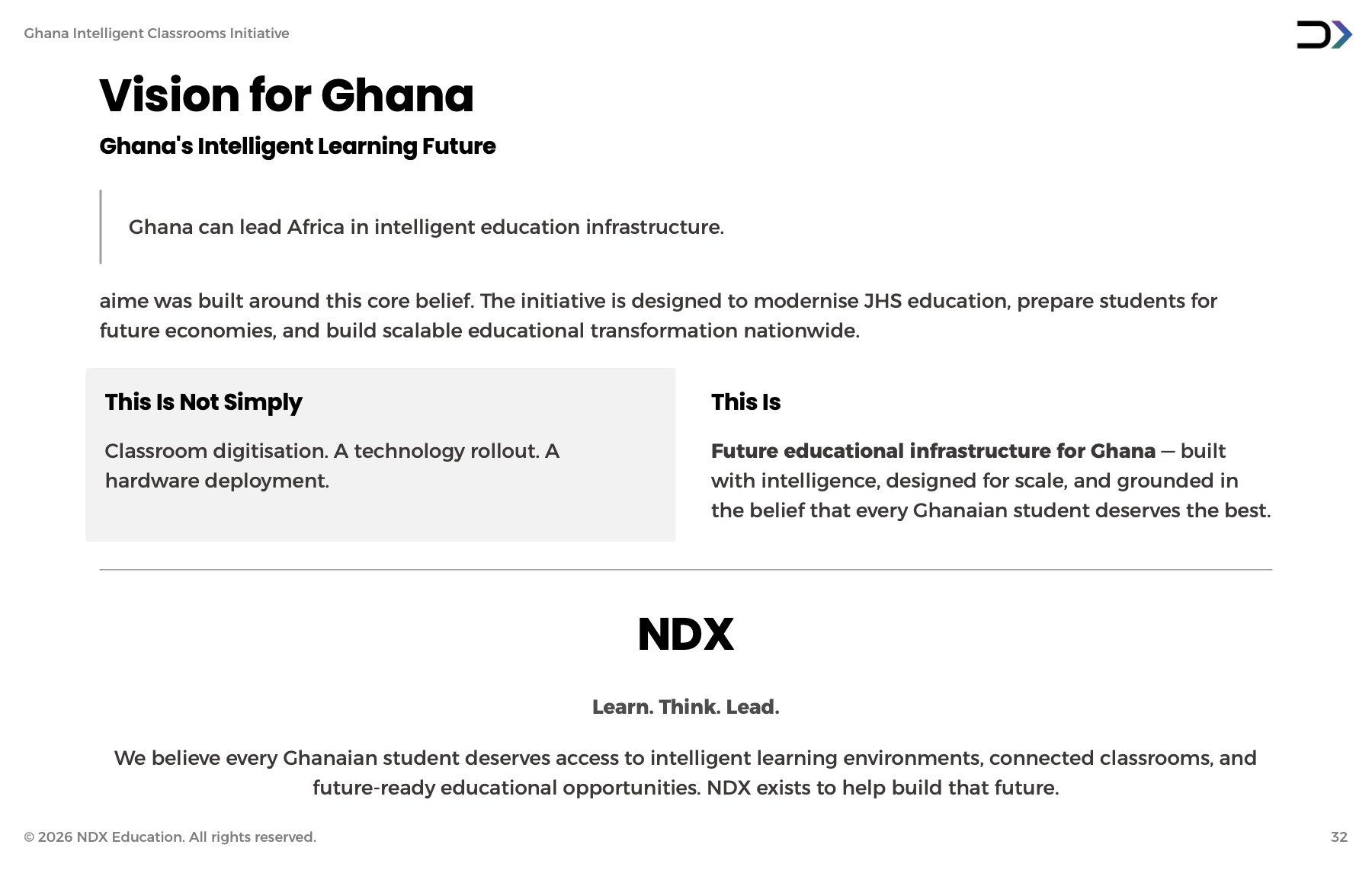
Concept slide describing Ghana's intelligent learning future
Concept deck: Vision for GhanaOpen full image